Research proposal / July 2026

Can motion embeddings survive bad poses?

A retrieval-first study of whether contextual metric learning can keep similar motion sequences near each other when estimated joints jitter, disappear, or arrive in broken frames.

Foundation
ICML 2023
Transfer
Images → motion
Status
Open hypothesis

System view / research question

Pose → context → retrieval
Corrupted query → clean-gallery retrievalExplanatory animation / not measured output

01 / Planned corruptions

First, make the pose observation fail.

The detailed lab separates joint jitter, missing limbs, and frame loss so the planned stress test stays interpretable. The clean sequence remains visible as a fixed reference.

Interactive 01

Pose corruption lab

Planned protocol / simulation

Clean and corrupted pose sequenceA clean animated skeleton is compared with an observed skeleton under the selected synthetic corruption and severity.CLEAN REFERENCEOBSERVED QUERY
Corruption
Frame 1/6

Explanatory simulation of the proposed corruptions—not a model output or measured robustness result. Use the frame controls for a static comparison.

02 / Origin

A small keypoint error did not stay small.

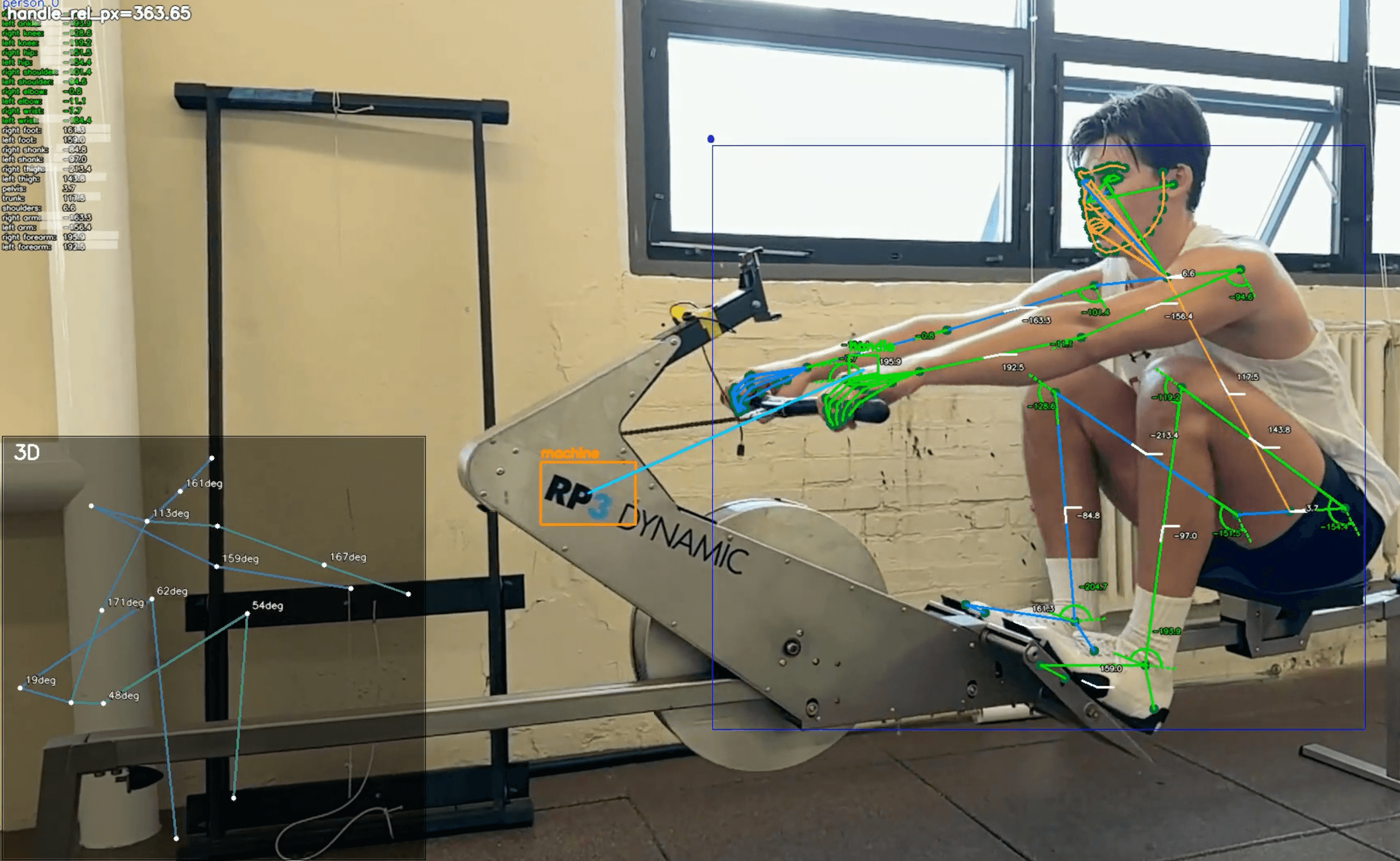
The rowing pipeline exposed the failure chain. Motion blur, occlusion, oblique views, and tracking discontinuities displaced joints; monocular lifting added depth uncertainty; velocity and acceleration features amplified what remained.

That practical problem became a narrower research question: if the pose observation is unreliable, can the ordering of a motion embedding space remain useful?

Rowing case study
Real rowing pipeline footage. This is the source of the research question, not evidence that the proposed loss solves it.

03 / Retrieval intuition

A pair is fragile. A neighborhood adds context.

Cosine retrieval asks whether one query vector is close to one gallery vector. Contextual similarity also asks whether those examples agree about who else belongs nearby.

Shared and reciprocal neighbors create a local-consensus signal. The proposal tests whether that inductive bias degrades more slowly than direct pairwise objectives under pose corruption.

Interactive 02

Neighborhood explorer

Synthetic intuition demo

Query sequence
Ranking signal
Synthetic embedding neighborhood for query R1Twelve motion embeddings in three labeled classes. Lines show the selected query ranking and, in contextual mode, shared and reciprocal neighborhood relations.R1R2R3R4S1S2S3S4T1T2T3T4

The points are deterministic teaching data. They show how a perturbed pairwise score and a neighborhood-derived score can order the same batch differently; they do not predict an experimental outcome.

04 / Foundation → extension

Same objective. Different failure.

The transfer changes the data and the corruption, not the central loss. A temporal encoder replaces the image network; the contextual construction still operates on a balanced batch of normalized embeddings.

What is established

The 2023 paper reports improved image retrieval, less overfitting, and greater robustness to label noise.

What remains untested

Whether the same loss preserves pose-sequence retrieval when input coordinates—not labels—become unreliable.
Comparison of the ICML 2023 foundation and the proposed pose-sequence extension
DimensionICML 2023 foundationProposed extension
DomainStill imagesTemporal skeleton sequences
ObservationImage embeddingT × J × C joint coordinates → motion embedding
StressorInconsistent or noisy labelsJitter, occlusion, frame loss, pose-source shift
TaskSupervised image retrievalClass-level pose-sequence retrieval
EvidenceReported by Liao et al., ICML 2023Open hypothesis; no robustness result yet
  1. 01

    Sequence

    x ∈ ℝᵀˣᴶˣᶜA tracked body across T frames, J joints, and C coordinates.
  2. 02

    Embedding

    z = fθ(x) / ‖fθ(x)‖₂MotionBERT supplies the temporal encoder; the output is normalized.
  3. 03

    Geometry

    S = ZZᵀ · D = 2 − 2SCosine similarity and unit-sphere squared distance describe every pair.
  4. 04

    Neighborhood

    Nᵢⱼ = 𝟙[Dᵢⱼ ≤ dᵢ,ₖ + ε]Expanded top-k neighborhoods turn pairwise distances into local structure.
  5. 05

    Context

    W₁ → R → W₂ → WShared agreement, reciprocal neighbors, query expansion, then symmetry.
  6. 06

    Objective

    λLcontext + (1−λ)Lcontrast + γLregThe hybrid loss combines contextual fit, pairwise margins, and regularization.

Balanced batch. The neighborhood size k equals samples per represented class and must be even for the reciprocal k/2 step.

Discrete forward, useful backward. The comparison is binary in the forward pass; a straight-through estimator supplies a constant heuristic gradient during training.

Bounded cost. Context construction is cubic in batch size, so the experiment profiles moderate balanced batches before any full-encoder run.

Interactive 03

Contextual matrix microscope

3 classes × 4 samples / k = 4

R1R2R3R4S1S2S3S4T1T2T3T4R1R2R3R4S1S2S3S4T1T2T3T4

This fixed 12-sequence batch is intentionally small. The browser mirrors the construction order for explanation only; training-scale contextual computation is cubic in batch size.

05 / Proposed experiment

A useful result either way.

The study isolates the loss before expanding scope. There are no completed robustness results yet; the deliverable is a controlled comparison whose null outcomes remain interpretable.

Dataset
NTU RGB+D 120, using its official cross-subject and cross-setup protocols.
Encoder
Pretrained MotionBERT with a normalized projection output; freeze first, fine-tune later.
Retrieval
A saved, disjoint query/gallery manifest with noisy queries against a fixed clean gallery.
Corruptions
Body-scaled Gaussian joint jitter, joint or limb masking, frame dropout, temporal jitter, and pose-source shift when available.
Controls
The same split, backbone, sampler, embedding dimension, augmentations, tuning budget, evaluator, and seeds for every loss.
Metrics
Recall@1/5/10, mAP, mAP@R or R-precision, retention, and clean-to-corrupted degradation.

Three go / no-go milestones

  1. 01

    Protocol validation

    Reproduce the starting pipeline, save the held-out query/gallery split, and require monotone corruption curves from frozen embeddings.

  2. 02

    Loss isolation

    Train matched projection heads with SupCon, contextual, and hybrid objectives; verify that batch composition, k, and samples per class agree.

  3. 03

    Robustness claim

    Fine-tune only after milestone two is stable, then add the corruption-aware MaskCLR control and the full matched ablation.

How each possible result would be interpreted
Observed patternScientific interpretation
Robust gain with similar clean retrievalEvidence that contextual neighborhoods help under input corruption.
Clean gain, no robustness gainBetter ranking, but not support for the pose-noise hypothesis.
Gain only with corruption augmentationNeighborhood learning and robust data exposure are complementary.
No gain over SupCon or MaskCLRThe encoder or corruption-aware training matters more than this objective.

06 / Papers, code, artifacts

The evidence trail.

Primary papers and canonical repositories, grouped by the role they play in the proposal.

Current work

  1. A1

    Robust pose-sequence retrieval prospectus

    The eight-page July 2026 literature review, feasibility assessment, and proposed experiment.

  2. A2

    Pose embedding repository

    The implementation workspace and study artifacts for the proposed extension.

  3. A3

    Rowing biomechanics origin

    The case study where noisy tracking, uncertain 3D lift, and derivative amplification made the robustness question concrete.

Foundation

  1. F1

    Contextual similarity optimization

    Liao, Tsiligkaridis, and Kulis, ICML 2023. The image-retrieval objective and label-noise evidence this proposal transfers.

  2. F2

    MotionBERT

    The pretrained temporal motion encoder and public one-shot NTU pipeline chosen as the lowest-risk starting point.

  3. F3

    NTU RGB+D 120

    A large-scale skeleton action benchmark with standard cross-subject and cross-setup evaluation protocols.

Robustness controls

  1. R1

    MaskCLR

    The closest robustness-specific comparator and the source for joint noise, occlusion, frame masking, and pose-estimator-shift tests.

  2. R2

    PoseConv3D

    Independent evidence that estimated-pose representations can be tested for noise robustness and cross-dataset transfer.

  3. R3

    Skeleton-DML

    Direct precedent for deep metric learning and nearest-neighbor recognition on skeleton sequences.

Research question

Is local neighborhood structure useful when the observations, rather than the labels, become unreliable?

Read the full proposal