2025 / Research / Technical Writing
Forging Adaptability
A literature-based examination of systematic compositionality, continual learning, adaptive plasticity, and the limits of biomimetic AI.
- Role
- Researcher and author
- Focus
- Systematic compositionality / Meta-learning / Continual learning / Adaptive plasticity
The research question
The paper asks whether selected principles associated with modular brain organization and hierarchical feedback can improve how artificial neural networks combine known elements, retain prior knowledge, and remain plastic over time.
Biomimicry is treated as a source of targeted mechanisms, not a claim that artificial hardware reproduces the brain. The evidence comes from recent literature rather than experiments run for this project.
Learning compositional rules
Lake and Baroni's MLC approach trains a standard transformer across dynamic few-shot episodes. Each episode provides study examples for a compositional grammar, then asks for a novel query that recombines elements encountered during study.
The important distinction is the learning process: the cited method is optimized to infer and apply compositional rules instead of memorizing a fixed set of input-output patterns. Numeric validation figures are omitted because the delivered PDF truncates the sentence containing them.
Retaining knowledge with context control
The continual-learning study introduces two PFC-inspired motifs. Sluggish task units carry recent context through an exponential moving average, while a Hebbian update gates task-relevant hidden units and helps separate task representations during sequential learning.
These mechanisms belong to a distinct cited model. They are not connected to MLC as one runtime, and the case study does not invent a larger neural topology around them.
Plasticity loss and intervention
The paper summarizes dormant units, declining effective rank, and problematic weight dynamics as mechanisms associated with plasticity loss during prolonged standard training.
Continual backpropagation is presented as a documented intervention that reinitializes less-used units. This project does not claim to implement or evaluate it, and the atlas keeps the intervention outside an automatic feedback loop.
The remaining biological and AI boundary
The literature supports a careful conclusion: specific brain-inspired mechanisms can improve specific learning capabilities without establishing human-like general intelligence.
Biological brains and artificial hardware operate under very different physical constraints. The paper therefore ends with a translation gap, not a unified architecture or a claim that biomimicry alone closes the distance.
01 / Evidence atlas
Three studies, held apart
Select a lane to inspect its mechanism, evidence, and boundary. The atlas keeps the cited programs independent so a literature review does not read as one implemented neural system.
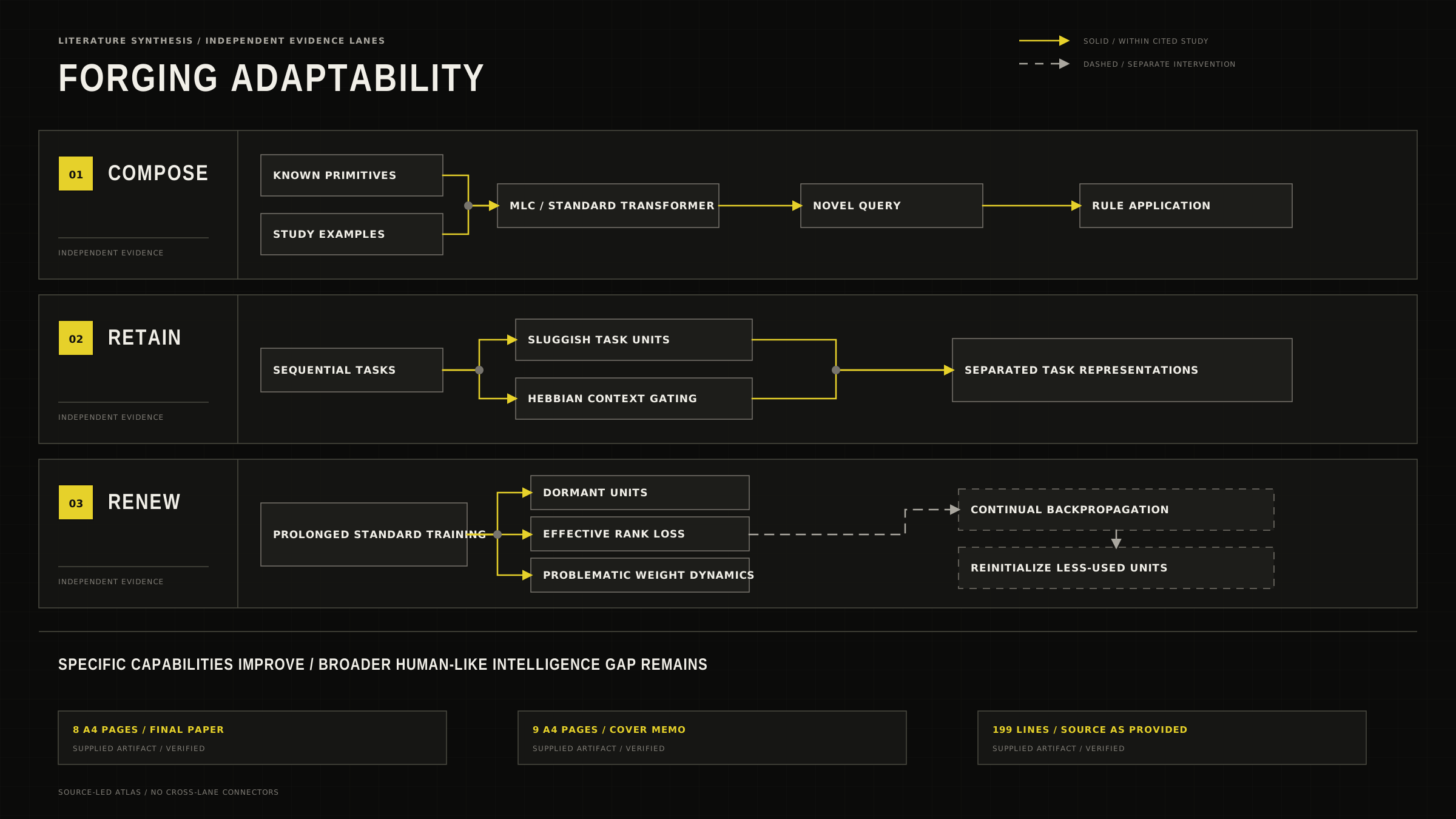
- Mechanism
- Three independent evidence lanes organize the paper around composing, retaining, and renewing learning capacity.
- Evidence
- MLC episodes, PFC-inspired context mechanisms, and plasticity-loss mechanisms are reviewed as separate research programs.
- Boundary
- This is a literature synthesis, not one executable architecture. The cited experiments are not presented as original measurements.
- Source
- Final paper sections 2, 3, and 4.
Overview. Mechanism: Three independent evidence lanes organize the paper around composing, retaining, and renewing learning capacity.. Evidence: MLC episodes, PFC-inspired context mechanisms, and plasticity-loss mechanisms are reviewed as separate research programs.. Boundary: This is a literature synthesis, not one executable architecture. The cited experiments are not presented as original measurements.. Source: Final paper sections 2, 3, and 4.
Read the paper as delivered
Five curated pages span the research question, compositionality, continual learning, plasticity mechanisms, and conclusion. Each preview preserves the full A4 page.
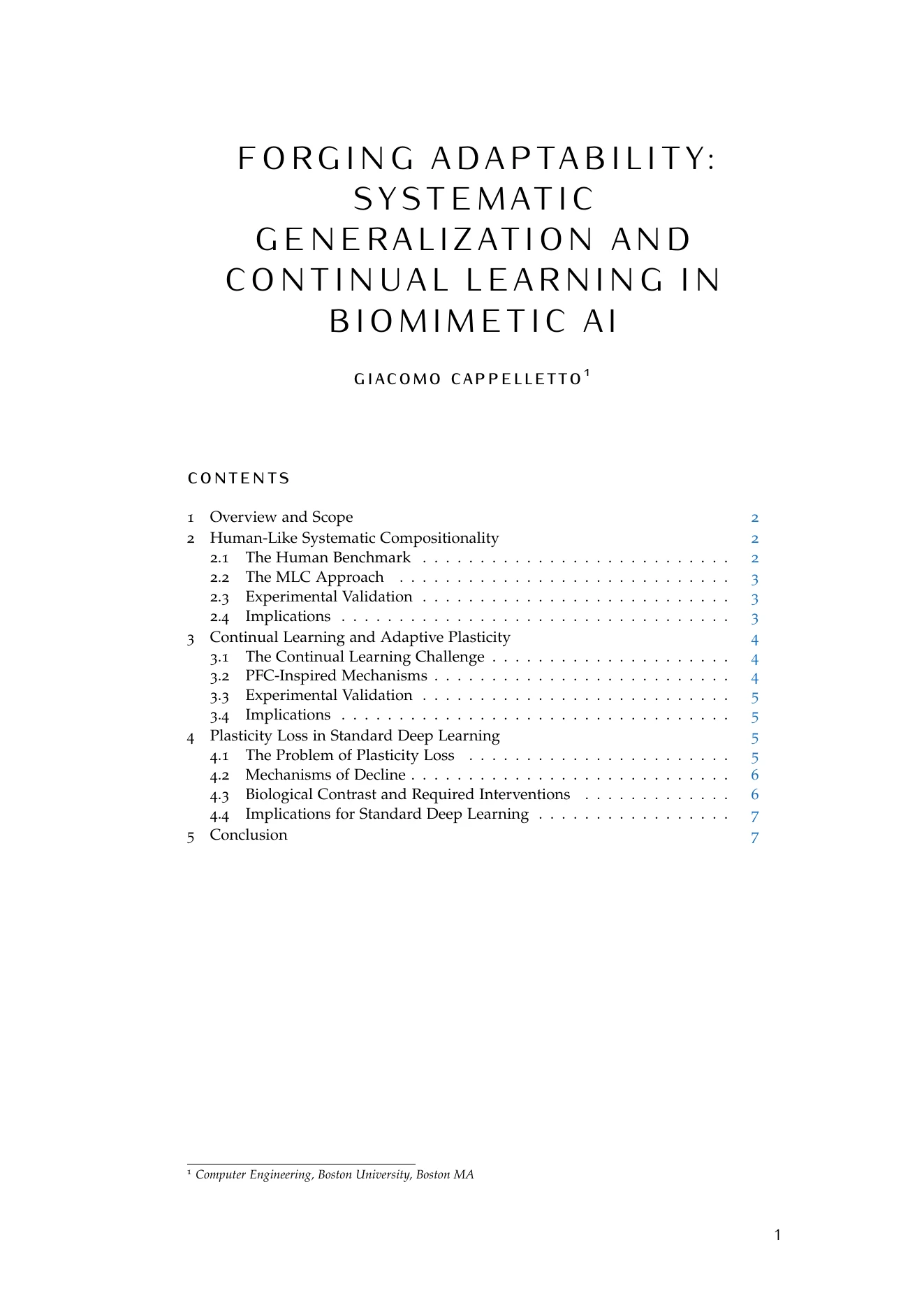
Title, contents, and the paper's five-section map from scope through conclusion.
This is source evidence from the delivered PDF, not a recreated or corrected page.
Selected final paper page 1 of 8. Title, contents, and the paper's five-section map from scope through conclusion.
The complete artifact bundle
All three files are byte-preserved from the supplied attachments. The PDFs are delivered artifacts; the TeX is supporting source as provided.
Final paper
8 A4 pages with embedded fonts and no raster images. This is the delivered paper artifact.
Download final paperPDF / COVER MEMOCover-memo edition
9 A4 pages containing the cover memo and highlighted revision evidence alongside the paper.
Download cover memoTEX / SOURCE AS PROVIDEDTeX source
199 lines. It references structure.tex and article.bib, which were not supplied, so this is not a standalone compile bundle.
Download TeX source